

Does Your Chaparral Boat Table Accessory Fit?
Last Updated: October 28, 2026
Quick Summary
Chaparral boat table accessory fitment means matching an accessory to your boat's table mount system, since the mount type and diameter, tabletop interface, and boat model and year decide whether a part fits. Identify your mount family, measure the post and bolt pattern, and compare those numbers to the supplier's published dimensions before ordering.
- Four mount families exist: fixed pedestal, removable socket, folding leg, and surface-mount base plate.
- The last two digits of the hull identification number encode the model year.
- Measure post diameter at two points 90 degrees apart to the nearest 1/16 inch.
- On a six-hole pattern, measure across opposite holes for the bolt circle diameter.
- Keep heavy loads centered over the pedestal and never use a table as a step.
Table of Contents
- Why Chaparral Boat Table Accessory Fitment Starts With the Mount
- Common Marine Table Pedestal Mount Types on Chaparral Boats
- Measuring Your Tabletop and Mount for Custom Marine Accessory Fitment
- Troubleshooting Boat Table Pedestal Wobble and Loose Fits
- Matching Accessories to Your Chaparral Boat Table
- Check Your Mount Fit With JewlsCustoms
- Frequently Asked Questions
Why Chaparral Boat Table Accessory Fitment Starts With the Mount
Chaparral boat table accessory fitment means matching an accessory to your boat's table mount system.
At JewlsCustoms, we build stainless steel accessories around one hard truth: the mount decides everything.
The Three Things That Decide Whether an Accessory Fits
Three variables govern every fitment decision:
- Mount type and diameter. A fixed pedestal, a removable socket, and a folding leg system all accept different hardware.
- Tabletop interface. The bolt pattern and plate size under your table must line up with the mount's top plate.
- Boat model and year. Chaparral changed table hardware across model years and hull layouts, so two boats that look identical can take different parts.
Common Marine Table Pedestal Mount Types on Chaparral Boats
Marine table pedestal mount types fall into four broad families.
The Four Mount Families and How to Recognize Each
- Fixed pedestal. A rigid aluminum or stainless post bolted to the deck and to a top plate under the tabletop. You cannot lift the table out without tools. Common in cockpit tables on SSi and SSX models. Recognition cue: no deck socket, no release collar, continuous post.
- Removable socket mount. The post drops into a flush deck socket and lifts out for storage. Look for a round or oval deck fitting with a set screw, cam lever, or twist-lock collar. Popular on Sunesta and SSX. Recognition cue: the post lifts free when you pull straight up.
- Folding leg table. Legs fold flat under the tabletop; there is no pedestal at all. Often found in bow and filler-cushion areas. Recognition cue: two or four hinged legs with rubber or plastic feet, and a table that stores in a dedicated locker.
- Surface-mount base plate. A flat plate screwed or through-bolted to the deck that accepts a post or accessory arm. Recognition cue: a visible plate footprint with four to six fasteners and a central receiver.
A Model-and-Year Fitment Framework
You can record four data points to help describe your setup:
- Hull identification number (HIN). The last two digits encode the model year, the authoritative year, not the title or dealer's description.
- Model line and length. SSi, SSX, Sunesta, Signature, and H2O lines used different table hardware families across generations.
- Table location. Cockpit, bow filler, and helm tables on the same boat often use different mounts.
- Mount family from the list above. Once you know the family, the replacement-part universe narrows to a handful of options.
Record those data points to describe your setup.
How to Identify Your Mount in Under Five Minutes
Follow these steps in order:
- Lift or remove the tabletop and note whether the post is fixed or lifts out of a socket.
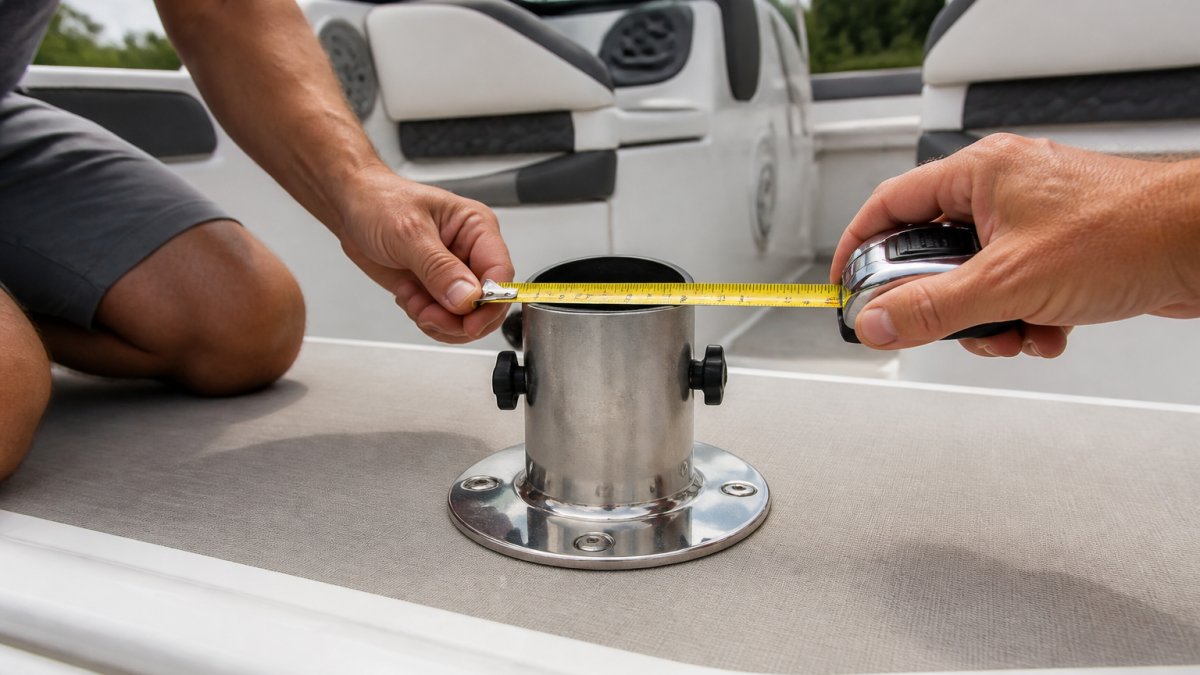
- Measure the post diameter with a tape or calipers to the nearest 1/16 inch.
- Measure the base plate or deck socket diameter across its widest point.
- Count the mounting screws and measure center-to-center spacing on the base plate.
- Photograph the mount from above, from the side, and from underneath the tabletop.
- Write down your hull identification number and model year.
That record answers most fitment questions before you contact a supplier.
Measuring Your Tabletop and Mount for Custom Marine Accessory Fitment
Measurements such as diameter, bolt spacing, thickness, and height can be relevant to accessory fitment.
What to Measure Before You Order
Record these six measurements, plus the method used for each:
| Measurement | Where to Take It | Method | Why It Matters |
|---|---|---|---|
| Post diameter | Across the pedestal post, at two points 90 degrees apart | Calipers preferred; tape measure acceptable to the nearest 1/16 inch | Determines socket and collar size |
| Base plate diameter | Across the deck plate at its widest point | Tape measure, flat across the plate | Confirms the mount footprint |
| Bolt hole spacing | Center to center of adjacent mounting screws, then across the pattern | Measure both axes; do not assume a square pattern | Matches the replacement plate |
| Tabletop thickness | Edge of the table at three points | Calipers or tape | Controls bolt length and clearance |
| Tabletop length and width | Longest and widest points | Tape measure | Confirms accessory swing clearance |
| Mount height | Deck to underside of table | Tape measure, boat level | Sets seating and legroom |
How to Measure Bolt Patterns Correctly
- Four-hole pattern. Measure center-to-center across adjacent holes on both axes. Matching numbers mean square; differing numbers mean rectangular, and both matter.
- Six-hole pattern. Measure across opposite holes (the bolt circle diameter), not adjacent holes, which understates the circle.
- Through-bolted vs. screwed. Through-bolts pass through the deck with a nut and backing plate; screws thread into the deck or a tapped plate. Note which you have, because replacement hardware must match.
Tolerance and Fit Verification
Before ordering, verify fit three ways:
- Compare your measurements to the supplier's published dimensions, not the product photo. Photos are frequently of a different size variant.
- Confirm the bolt pattern orientation, a plate that matches on spacing but is rotated 45 degrees will not line up.
- Ask for the return policy in writing, custom-machined parts often carry restocking fees, and a supplier who will not confirm fitment before the sale is a risk.
OEM Versus Aftermarket Replacement Parts
- Material grade. Look for marine-grade stainless steel (316 where the part sees salt spray), not plated steel that pits in salt air.
- Machined fit. A mount made to your measured diameter seats without shims.
- Finish. Polished or brushed finishes hold up better against spray and sun than painted or coated surfaces that chip.
- Hardware included. Good kits ship with the right bolts, washers, and backing plates, not a generic bag.
Troubleshooting Boat Table Pedestal Wobble and Loose Fits
- Loose base plate. Check the deck screws first. Back them out, add a marine sealant, and re-torque.
- Worn collar or bushing. A plastic bushing flattens over time. Replace it before the post starts scoring the socket.
- Undersized post. If the post rattles in the socket, the diameters don't match. A shim is a stopgap, not a fix.
- Warped tabletop. A table that rocks on a flat surface will rock on the boat too.
Load Limits and Safe Installation
- Keep heavy loads centered over the pedestal, not at the table edge.
- Never use a table as a step, handhold, or boarding aid.
- Check mounting hardware at the start of each season.
- Add a backing plate under the deck when installing a new base in a thin panel.
- Stow umbrellas and grills before getting underway.
Matching Accessories to Your Chaparral Boat Table
- Grill stanchions need a solid pedestal or base plate with enough footprint to resist tipping.
- Umbrella mounts need a post diameter that matches exactly, plus clearance for the canopy.
- Flag pole kits work best on a dedicated base rather than a shared table socket.
- Replacement tabletops must match the bolt pattern and thickness of your existing mount.
Our stainless steel accessories are customizable to fit your boat's specific table mount system. Our customers have rated us 4.82 stars across 229 verified reviews. You can check out our range.
Check Your Mount Fit With JewlsCustoms
At JewlsCustoms, we specialize in boat table mount accessories. Our stainless steel products are customizable to fit your boat's specific table mount system and are designed to withstand harsh marine environments.
Get started with JewlsCustoms and upgrade your table setup.
Frequently Asked Questions
How do I identify my Chaparral boat table mount type?
Look under the tabletop for the socket or base style. Common types include a flush deck socket with a removable pedestal, a fixed pedestal base, and a side-mount bracket on the console or gunwale. Measure the socket inside diameter and the pedestal outside diameter in millimeters. Check the base plate bolt pattern and any part number stamped on the hardware. A photo of the mount sent to the accessory maker confirms fitment before you order.
Are marine table accessories universal for Chaparral boats?
Fit depends on your boat's specific table mount system. JewlsCustoms offers customizable marine accessories designed to fit a boat's specific table mount system.
Can I add a grill or flag pole to my existing table mount?
Yes, if the mount is rated for the load and the accessory uses the same socket or base pattern. A grill stanchion or flag pole kit slides into the pedestal socket or bolts to the base plate. Check the load limit of the mount and deck reinforcement before adding weight above the tabletop rating. For safety, keep the accessory centered over the pedestal and secure any locking pin or set screw before getting underway.
How do I troubleshoot a loose or wobbly boat table pedestal?
Start by checking the set screw or locking collar at the socket; tighten it if the pedestal rocks. Inspect the base plate bolts for looseness and tighten them to the deck. If the socket itself is worn, a replacement socket or shim restores a snug fit. For wobble that persists, remove the pedestal and look for cracks or elongation in the deck mounting holes. Replace worn hardware rather than over-tightening, which can damage the deck core.
